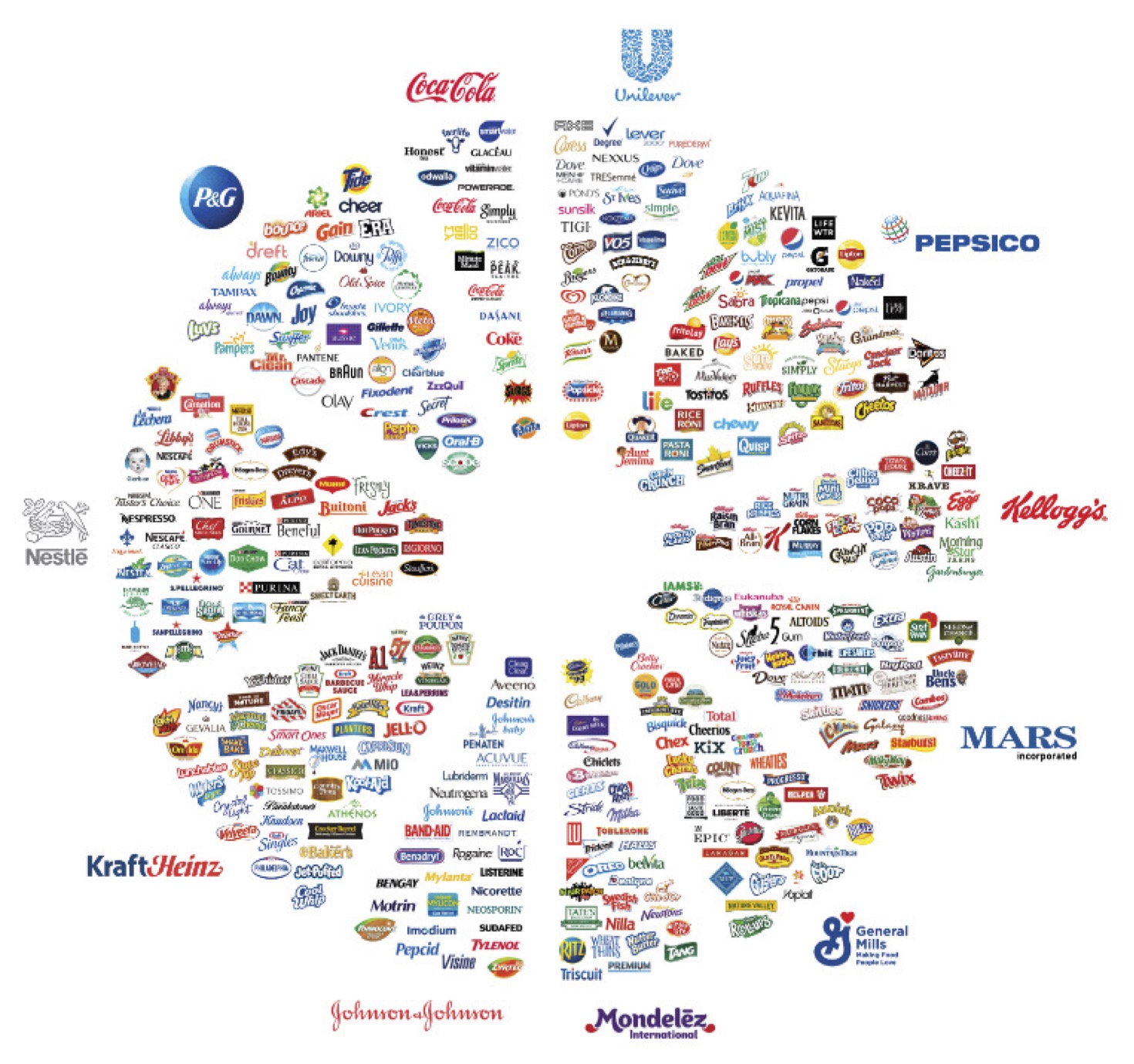
 For my book talks this past year I’ve been illustrating how Minute Tapioca got swallowed up in a succession of corporate ownerships, starting with General Foods (née Postum) in the 1920s and accelerating through Philip Morris’s mad aquisition spree in the late 20th century that gobbled up GF, Kraft, and Nabisco and eventually merged them with Heinz under the new ownership of financial giants Berkshire Hathaway and 3G capital.
It makes for a grabby visual, especially when I get to the graphic that shows how behemoth Kraft Heinz is just one slice of the huge pizza pie that is the highly-consolidated modern food economy.
Now the overlords have decided they need to break up Kraft Heinz, according to Claire Kelloway’s good piece in Food & Power this week. The reason? Turns out there is such a thing as too big.
Economies of scale only work up to a point, after which you’re just scraping profit off pared-down operations that are dying inside – in this case because in a very saturated market, public taste has been turning away from the kinds of highly-processed packaged foods that all these companies made their names on.
The giants continue to dominate the grocery business despite all that, because of the complex and symbiotic ways they all prop each other up (for example, in the practice of “slotting fees,” the let’s-not-call-it-a-bribe system whereby big food manufacturers literally pay supermarkets for prime shelf space).
But this kind of experiment in devolution, which echoes Unilever’s spinning off its ice cream division into a separate company (a breaking-point for Ben & Jerry’s co-founder Jerry Greenfield BTW), makes me wonder. To me this sounds a lot like a slowly-receding wave, signaling that the manic expansionism of the past century in the industrial food system may have finally reached its end-point and the winners are now just desperately struggling to hold on.
Maybe we’ll start to see somewhat less-unwieldy giants, on the scale of the General Foods of the earlier part of the century. Or maybe corporate investment will start to migrate to other less saturated sectors.
And maybe, as it sometimes seems, things will continue along the expansion track and we’ll just end up buying all of our food from either the Walton family or Jeff Bezos or whoever else manages to survive the current scramble for our grocery dollars. I’m envisioning that as a new slide in my deck, and hoping it’s startling enough that it helps make my case for supporting the actual alternatives that do exist at very different scales.
